
FinCEN, CIA, FBI: within weeks, three US agencies sitting on huge troves of data have reported break-ins. The cases show how vulnerable the infrastructure is that makes citizens ever more transparent – and why that matters for Switzerland too.
What happened
The first signs were easy to miss. On 18 November, service providers that file reports on behalf of banks noticed that their automated batch submissions to FinCEN were no longer going through. Two days later, the agency reported a disruption to its SDTM batch filing system.
On 24 November came the admission. FinCEN, the US Treasury’s financial intelligence unit, is investigating a cybersecurity incident that “resulted in unauthorized access to a limited subset of its systems.” It has taken some systems offline as a precaution. Whether the disruption and the intrusion are linked, it won’t say.
At the same time, FinCEN issued order FIN-2026-R002, moving every filing deadline between 18 November and 29 December to 30 December. Notably, the order speaks only of a “service disruption.” It doesn’t mention an attack at all. For banks, every other anti-money-laundering obligation still applies.
What FinCEN holds
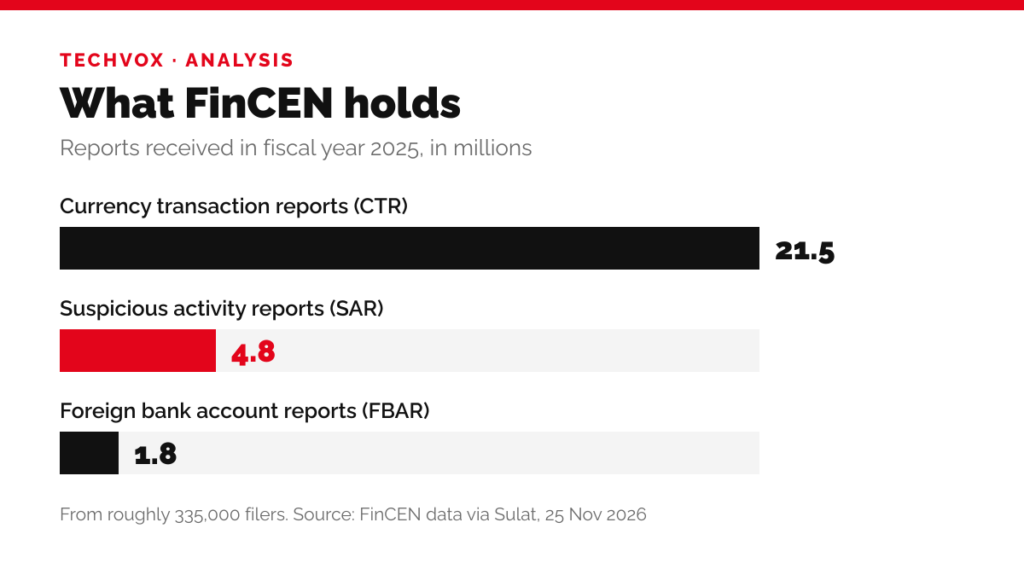
When a bank suspects money laundering or terrorist financing, it has to report it to FinCEN. That makes the agency one of the largest collection points for financial data anywhere. In fiscal year 2025, it received 4.8 million suspicious activity reports. On top of that came 21.5 million reports on large cash transactions and 1.8 million reports on foreign accounts, filed by roughly 335,000 institutions.
Then there is data on the beneficial owners of companies. Since a rule change in August 2026, this mainly has to be supplied by foreign companies registered to do business in the US. So Swiss owners of such companies can end up in these registers too.
Behind every suspicious activity report is a person who usually never finds out about it. A report isn’t a verdict. It’s one bank employee’s judgement. After an earlier attack on the Treasury, lawmakers Tim Scott and French Hill noted that the department holds “some of the most highly sensitive information on U.S. persons.”
Which systems the attackers reached, whether they copied or altered data, and who is behind it all remain open. FinCEN isn’t saying.
The CIA and FBI were hit too
The same day, Fox News, citing two sources, reported a breach at the CIA. The affected system is an unclassified network the agency uses to analyse open sources such as media, social networks and public data. According to The New York Times, the CIA and the Office of the Director of National Intelligence discovered the incident. An FBI source said the FBI had been attacked on the same day. The attackers and the scale are unknown.
An analysis network without a classified stamp sounds harmless. But it reveals what an intelligence service is looking for and which questions are on its mind.
For the FBI, it’s not the first case this autumn. In September, the ShinyHunters group stole staff data via the FBIJobs.gov recruitment portal. At the end of September, the FBI told its people internally that names, home addresses, job titles and Social Security numbers had been exposed. According to BleepingComputer, the weak point was a platform run by an outside contractor.
The pattern: the weak spot is at the edge
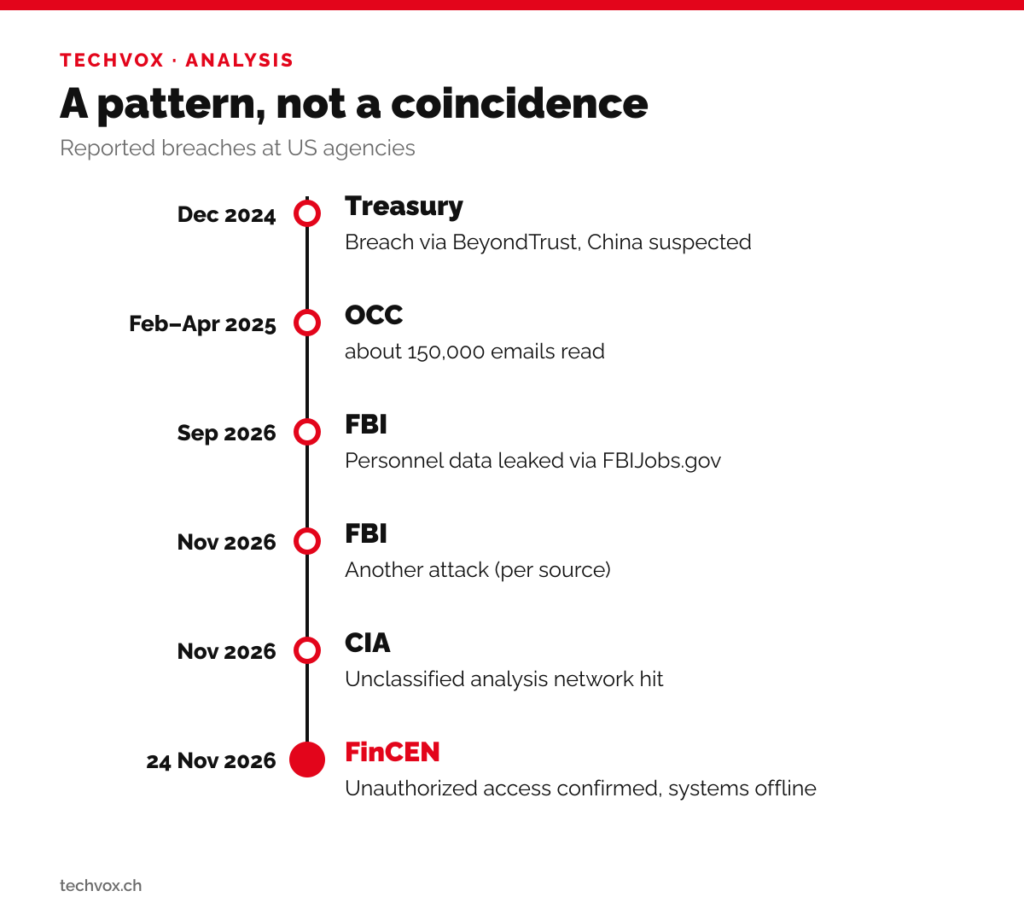
Autumn 2026 is no outlier. In late 2024, attackers broke into the US Treasury after stealing a key from the remote-support vendor BeyondTrust. The department blamed a Chinese state-sponsored actor. In early 2025, unknown attackers read emails at the bank regulator OCC, about 150,000 according to Bloomberg.
What stands out is where the attackers strike. Rarely at the well-guarded core. More often at suppliers, remote-support services and contractor portals. The more parties are plugged into a central database, the more doors there are.
| Date | Agency | Affected | Attacker |
|---|---|---|---|
| Dec 2024 | US Treasury | Workstations and unclassified documents (via vendor BeyondTrust) | Chinese state-sponsored actor (per Treasury) |
| Feb–Apr 2025 | OCC (bank regulator) | about 150,000 emails (per Bloomberg) | not confirmed |
| Sep 2026 | FBI | Personnel data via FBIJobs.gov: names, addresses, job titles, Social Security numbers | ShinyHunters (claimed) |
| Nov 2026 | FBI | another attack (per an FBI source) | unknown |
| Nov 2026 | CIA | unclassified open-source analysis network | unknown |
| 18–24 Nov 2026 | FinCEN | “limited subset” of systems, filing systems offline | unknown |
And Switzerland?
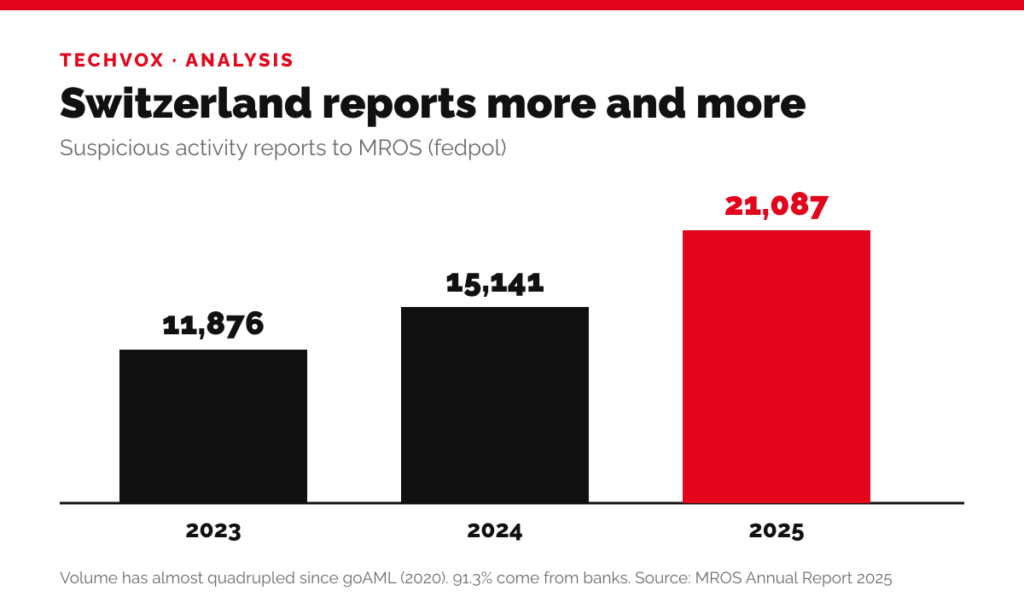
Here, too, every suspicious activity report ends up in one place: MROS, the Money Laundering Reporting Office at fedpol. Since 2020, reports have been submitted exclusively through the goAML digital platform. In 2025 there were 21,087, about 39 per cent more than the year before. Since goAML was introduced, the volume has almost quadrupled. More than 91 per cent of reports come from banks.
MROS itself notes that many reports are incomplete or of little value. Financial institutions increasingly file as a precaution, so no one can accuse them of having failed to act. The result is more data on more people, but not necessarily better leads.
The office is reaching its limits. In September 2025, the Federal Council asked the justice department to examine new funding models for MROS, including fees. And anyone who is reported usually never learns about it. The Anti-Money Laundering Act explicitly bars banks from telling their clients about a report.
The Xplain case showed that federal data isn’t untouchable. In 2023, the Play ransomware group attacked the Bern-based IT service provider, which worked for fedpol among others. Because no ransom was paid, about 1.3 million documents ended up on the dark web, including more than 9,000 federal administration objects. According to the Federal Office for Cyber Security, more than half of them contained sensitive content, and 121 documents were classified. Here, too, the weak spot was the supplier.
The Techvox take
Central databases act like magnets. The more they hold, the more a break-in pays off. “Nothing to hide, nothing to fear” only works if the state keeps its own vaults locked. The last two years show it can’t do that reliably.
That’s not an argument against technology. Digital reporting systems make authorities faster and cheaper. But every extra form field, every lower threshold and every precautionary report adds to the data pile. Whoever collects data they don’t need creates risks they can’t control.
That leads to three questions that belong on the table in Bern too. How much really has to be reported, and for how long should it be stored? How are suppliers with access to sensitive systems vetted? And what analogue alternatives remain when digital systems fail or are compromised? Cash is one of them. It leaves no file that can be stolen.
What to watch now
Whether the US government classifies the FinCEN case as a “major incident” and notifies Congress, as happened with the Treasury in 2024 and the OCC in 2025. Whether the 30 December deadline holds or gets extended. And whether it becomes known which data actually left the building.
Your take: do we need a right to cash as an analogue backup?
Join the discussion in the Techvox Telegram group: t.me/techvoxch
Sources
- ABC News, 25.11.2026
- Fox News, 24.11.2026
- The Deep Dive, 25.11.2026
- Sulat, 25.11.2026
- NPR/OPB, 30.9.2026
- SecurityWeek
- Tech Insider (BleepingComputer/TechCrunch)
- MROS-Jahresbericht 2025 (fedpol)
- PwC Schweiz zur MROS-Statistik
- Bundesrat: BACS-Bericht zu Xplain, 7.3.2024
- Netzwoche zum Xplain-Bericht, 7.3.2024
- Tip-off: Verein WIR (vereinwir.ch)
Our processor runs on caffeine.
Techvox makes sense of technology, AI and digital policy in Switzerland, free of corporate money and algorithm dictates. Buy us a coffee and keep independent tech journalism running between Geneva, Zurich and Lugano.